Today, there are fast, affordable public speaking courses specifically designed to prepare you for a big speech in just a few hours or days.
Fear of public speaking is not a personal flaw; it is a prevalent anxiety that affects an estimated three out of four people worldwide.
The good news is that this fear responds well to structured practice, short training programs, and supportive feedback.
Why So Many People Fear Public Speaking
Studies show that around 75–77% of people experience some level of anxiety about speaking in public.
The underlying fear is often not the audience itself but the possibility of being judged, making mistakes, or “freezing” on stage.
Clinicians classify strong public speaking anxiety as a form of social anxiety disorder because the core concern is negative evaluation by others.
Two key facts
Some estimates suggest up to 90% of presentation anxiety is linked to lack of preparation and practice, not a permanent personality trait.
Second, safe environments—such as courses, clubs, or virtual simulations—help the brain “relearn” that speaking in public is survivable.
That is why quick, structured courses can make a visible difference in a short time.

What a “Quick” Public Speaking Course Usually Includes
Short public speaking programs compress the essentials into a few hours or weeks.
- Clear structure: Modules on speech planning, storytelling, body language, and voice control, usually broken into short video lessons or live sessions.
- Deliberate practice: Exercises where you record yourself, speak to a small group, or deliver mini-presentations with feedback.
- Anxiety management tools Include Techniques such as breathing control, simplified messaging, and gradual exposure to progressively more challenging situations.
- Actionable feedback: Checklists, peer comments, or instructor critiques that focus on specific behaviors (eye contact, pacing, structure) rather than vague “be more confident” advice.
Always check the official website before enrolling, as platforms run frequent discounts and regional promotions.
Option 1 – Toastmasters Public Speaking Course: Fast Track
Toastmasters International is widely known for its local speaking clubs, but it also offers “Fast Track,” a self-paced online mini-course.
The program combines an optional self-assessment, three instructional videos, a self-recorded speech, and a follow-up assessment.
It is designed specifically for people who need to prepare quickly for a presentation, interview, or special occasion speech.
Because it is entirely online and on-demand, you can complete it in a single evening if necessary.
Pirces
Fast Track costs 4.99 USD per course. This makes it one of the most affordable structured options on the market.
After Fast Track, some people join a local Toastmasters club for ongoing practice.
Toastmasters reports that membership requires $60 USD in semi-annual international dues plus a one-time $25 new-member fee.
Option 2 – Udemy Public Speaking Course
For a compact but intensive video course, Udemy hosts “Public Speaking: You Can be a Great Speaker within 24 Hours.”
The course description emphasizes practical skills for speeches, presentations, and PowerPoint talks.
It includes 11.5 hours of on-demand video and has a high user rating (4.7 out of 5, with over 1,000 ratings).
Udemy lists the current price as 11.99 USD, reduced from 39.99 USD, reflecting the platform’s frequent promotional sales.
Option 3 – Free University-Level Training on Coursera
Coursera hosts “Introduction to Public Speaking” by the University of Washington.
It is organized into five modules covering speech structure, making ideas memorable, and delivering with confidence.
The platform estimates a duration of one to three months at a part-time pace, but learners can move faster if they dedicate more hours per week.
Coursera’s pricing model
Many courses allow you to “enroll for free” and audit content at no cost, though graded assignments and certificates may require payment.
For broader access and certificates, Coursera Plus offers a subscription at $59 per month or $399 per year, granting unlimited access.
This makes Coursera attractive if you want a low-cost or free entry and are comfortable learning independently.
Option 4 – “Becoming a Public Speaker” (Knowadays – 8-Hour Intensive)
For learners seeking a short but more premium experience, the company Knowadays offers an online course called “Becoming a Public Speaker.”
The provider describes it as an 8-hour learning program that includes 4 modules, 12 video lessons, and a 62-page worksheet toolkit.
More importantly, the development of a five-minute talk is built to achieve a specific outcome.
This structure is aimed at professionals who want to move quickly from theory to a polished speech.
Pirces
Knowadays lists the price as $199 (USD), with alternative price labels shown for other currencies (for example, £99 and $99 for regional markets).
While more expensive than Udemy or Toastmasters Fast Track, it includes a curated toolkit and a clearly defined project, your five-minute talk.
This can be attractive if you need a concrete deliverable for work or a conference.
Practice Plan: Using Your Public Speaking Course
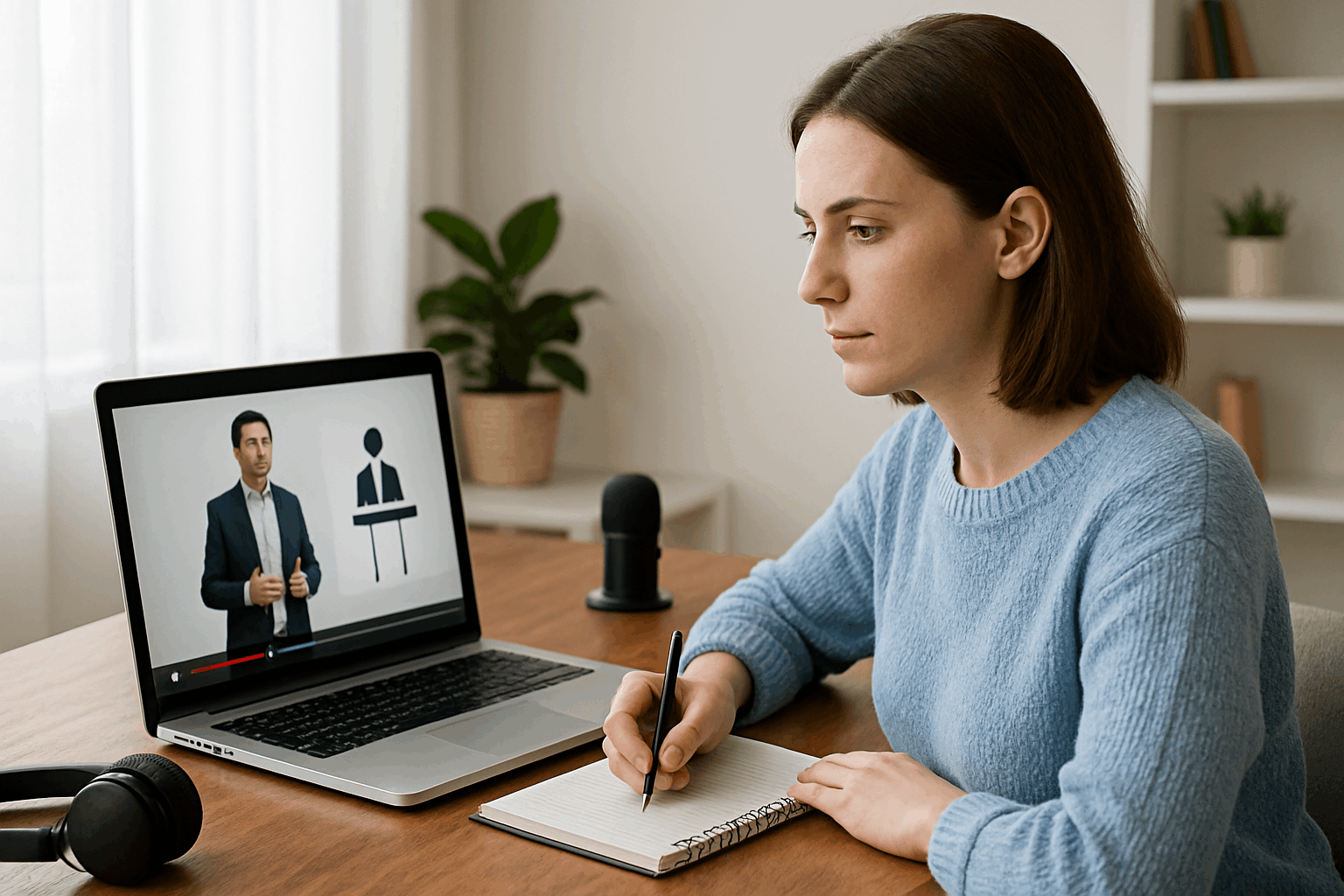
Public speaking courses online provide structure, but your anxiety decreases mainly through repeated, safe exposure to speaking situations.
Therapists and trainers frequently recommend a step-by-step approach: start with small, low-stakes tasks and gradually increase difficulty.
A practical plan using any of the courses above might look like this:
- Week 1 – Learn and script: Complete the first modules of your chosen course, then draft a two-minute talk on a familiar topic.
- Week 2 – Record and review: Film yourself giving the talk on your phone or webcam, then watch with a checklist from the course (posture, eye contact, structure). Repeat until you see specific improvements.
- Week 3 – Add a live audience: Present to one or two trusted colleagues or friends. Ask for concrete feedback (“Did I speak too fast?” “Was the main idea clear?”).
- Week 4 and beyond – Increase the stakes: Volunteer for short updates at work, join an online speaking group, or attend a Toastmasters meeting to keep practicing in different environments.
Recent reporting also highlights the use of virtual reality (VR) as a tool to gradually expose people to more challenging audiences.
From empty rooms to large virtual theaters—with promising results for reducing stage fright.
If your chosen course offers a VR companion or simulation, it can be a useful addition to this practice plan.
Conclusion
Mastering public speaking does not require years of training or a large budget.
Evidence shows that most people’s fear is common, understandable, and highly responsive to focused practice and step-by-step exposure.
In 2025, you can start with options ranging from a 4.99 USD to a 199 USD public speaking course, or even free university-level content.